How to contact support for new Release questions and extension

Support…I just received the e-mail about the new release of DUPLICATI and I have questions:

I’m a long-time user of the free version; in fact I loaded it on a Raspberry Pi 4 at least 5 years ago. It’s in a small, remote data center with several other Pi’s (e-mail, web, etc) each with an attached USB storage device. DUPLICATI is backing up those USB storage devices periodically.

Administration of DUPLICATI involves logging on to the DUPLICATI Pi via a VPN connection.

Questions:

  1. Can I continue to use the free version with my current setup?
  2. What are the advantages for me with the new system?
  3. How would I calculate the annual costs for using the new system?

Thanks…RDK

Absolutely. The Duplicati client continues to be free and open-source, no changes there.

I think the email you are mentioning is about the Duplicati console, where you can manage multiple Duplicati installations. The console is reducing the free tier, but if you do not use the console that is not relevant to you.

I would say, the 2.3 release has several new features and some performance improvements, so I don’t see a reason not to upgrade.

If you are using the open-source client, the price is zero. If you only want the console logging for that one machine, it is free as well. If you want to use the Pro subscription on the console, the price is $2/machine/month.

And you can reach support either via https://duplicati.com (click “Support” near the bottom) or write support@duplicati.com

@kenkendk Thanks for your reply and information.

Just checked and I’m running Duplicati - 2.0.8.1_beta_2024-05-07. As I’m remote to the site, I cannot initiate an update but I will be on site later this summer. Should I do the suggested update to Duplicati v2.1.0.2 or should I install the new, free 2.3 version?

If I install the new version, will I have to modify any settings?

Thanks….RDK

The 2.0 line runs on .NET4 (and mono on non-Windows), the 2.1+ line runs on .NET10 and does not use mono.

For that reason, the installation methods are not compatible, and it was not possible to port the automatic update part, so 2.1+ needs to be installed as a new application. This is the reason it suggests v2.1.0.2 but cannot automatically update.

I would always recommend installing the latest version. Each version has automatic upgrade logic, so you can install 2.3 and it will automatically update databases as needed. There might be some warnings when running a backup because we shuffled around some options.

@kenkendk Thanks for your reply. I’ve looked into that remote setup and have determined that the current version of Debian is obsolete, thus I will have to totally rebuild that Pi or a new one. When I do that I will probably install the Trixie version. This has me worried!

From your replies it appears I will be able to install the latest free version. But is there a process for saving and moving/restoring the settings and backups to the new Trixie setup? I really don’t want to lose the data/backups I have working now.

Thanks…RDK

Yes, this is described here:

Isn’t the database encryption by default now locked to system install, requiring obtaining key from its secret provider, which might not be willing to hand it out?

Release: 2.2.0.102 (Canary) 2025-12-12

I’m not sure what @ts678 is saying regarding my need to move my current setup to a new computer..RDK

First, did I understand the plan? You posted it as:

If you built a new Pi, then you might try document:

Previous machine is still available

which says you can just move all of the databases. I’m questioning that plan.
Long version of the question can be seen in my link to unanswered question:

Database Encryption Changes (2.3.0.1 release note – first written for 2.3.0.0):

If no secret provider is configured, and a default secret provider is available, the database will be encrypted with a random password stored in the default secret provider.

which probably means that Duplicati-server.sqlite is no longer guaranteed portable.
This has your job definitions, schedules, etc. I think the job databases are portable.

I’m thinking that the user manual should be updated as needed for new procedure.
Possibly you can just create an export of all jobs, and keep those somewhere safe.

True! You need to run Duplicati on the source system with --disable-db-encryption before taking a copy. I will update the docs.

@kenkendk @ts678 OK, you folks and any others watching this topic, I have just finished building a new Pi4B (4gb) setup with Trixie (64bit) and a 128 GB attached USB memory stick for storage. The old unit was also a Pi 4 but built back in 2020 with Buster, yes long of tooth and needs to be updated!! That server is not here at my current location, but I will be local to it in a couple weeks, so I’d like to set up a plan for moving the working functions of Duplicati to the new unit. I’m not really a computer guy, mostly just as a hobbyist.

Here is what I have: Duplicati is monitoring and backing up three other Raspberry Pi’s over its local network. Years ago, I did a test restore and it seemed to go fine.

I’ve reread this thread and have tried to piece together the process, but I’m really not confident I fully understand. Can someone provide a detailed process for moving Duplicati from the old device to the new one and getting it all running again? If there is a good document for this, then please a reference. I have a couple weeks to study and have additional questions.

Thanks…RDK

Edit: I have been reading the Migrating Duplicati to a new machine | Duplicati document and wow, it looks pretty good. But from experience I know that when i get into it there will be some detail, that is obvious to the authors but not to me, which i don’t understand. I’ll reread and try to note the areas where i have questions.

@kenkendk @ts678 As I suspected I have questions as I started going through the “Migrating Duplicati” document.

For background, my current setup is on a Pi4B with the OS Buster. Duplicati was installed in June 2022 using this wget command

wget https://github.com/duplicati/duplicati/releases/download/v2.0.6.3-2.0.6.3_beta_2021-06-17/duplicati_2.0.6.3-1_all.deb

and then an sudo APT install.

The new Raspberry Pi4 will have Trixie as the OS. FSTAB and related files have been copied to the new setup.

Questions:

  1. Installing on Linux Debian
    sudo dpkg -i duplicati-version-arch.deb
    I assume it sets up a service that starts the application during boot-up?

  2. The old setup is available and still in service.
    a. Stop Duplicati - How do I do this? I assume via the Web interface (http://10.0.99.101:8200/ngax/index.html#/) ?
    b. Start Duplicati with the command line option --disable-db-encryption=true
    How do I do this? Same question as a above?.
    c. Stop Duplicati again
    d. “copy over the contents of the Duplicati folder containing the configuration database Duplicati-server.sqlite and the other support database.” Where is this folder on the old setup and where will it be in the new setup?
    e. Start Duplicati on the new server with the command line option --startup-delay=5min

  3. If I understand correctly Duplicati will start from the state it was on the old setup before the copy?

Is there anything else I need to do or be aware of?..RDK

OK, I have figured out the location of the folder for Duplicati-server.sqlite file, (/root/.config/Duplicati). Can I assume it will be the same for the new install?

It is still not clear how to run the Start Duplicati command line with this option, –disable-db-encryption=true. Do I use the “duplicati-cli” command from an SSH command line? Is that command valid for my older setup (duplicati - 2.0.8.1_beta_2024-05-07)?

Thanks…RDK

Using Duplicati with Linux will answer questions (and maybe add some more).

You can probably install just as you did before. Often a distro has easier ways.
For example most GUI file managers can install a .deb, e.g. by using GDebi.
Personally I prefer either of those to dpkg, as they get needed dependencies.

No, but the right way depends on “Deciding on type” at top of page I linked.
For example, Tray Icon run as you has a right click menu with a “Quit” on it.

Is that the type you now use, and what you want again? If so, please see

Using Server as a Service

For systemd service, this is described in section I just linked. Other use varies.

Can be custom, but Database location has defaults. Also The local database.

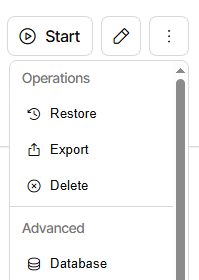
You can also find the job and server databases in GUI job “Database” screen:

My plan is install Duplicati as indicated in the documentation for “install on Linux”. If there is a better way, please supply the details. As for the TYPE, I want the same “opensource free” version as i had for my previous 2022 installation, whatever that was??

I still do not understand the process for doing the “Start Duplicati command line with this option, –disable-db-encryption=true.”. Which, according to “Previous machine is still available” is apparently necessary to decrypt the storage folder before copying to the new server. Do I use the “duplicati-cli” command from an SSH/PUTTY command line? If not, then what do I have to do?

Thanks…RDK

I guess I should have linked the section on that instead of just saying where it is.

Deciding on type

To use Duplicati on Linux, you first need to decide which kind of instance you want: GUI (aka TrayIcon), Server, Agent, CLI). The section on Choosing Duplicati Type has more details on each of the different types.

There are also a few added advanced features, but old uses remains free.
Duplicati console pricing explains the new remote console feature pricings.
Google Workspace Backup and “Office 365 Backup” below are proprietary.
You’re OK if you don’t use them. To be sure you don’t, it says how to avoid.

It would help if you said what you didn’t understand. Let’s look over the docs:

Using Server as a Service

If you need to pass options to the server, edit the settings file, usually at /etc/default/duplicati.

Assuming you want it as a service, you add that as shown there, then do the

sudo systemctl start duplicati.service

Although it’s not mentioned, the opposite of start is stop per a man page.

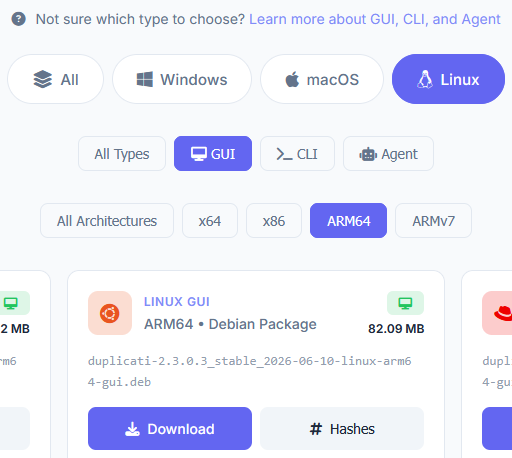
There is a variety of .deb files available, and a selector. Possibly you prefer:

https://updates.duplicati.com/stable/

but I don’t know your machine and usage, e.g. headless use would be different.

Regarding how to install a .deb, if you have GUI, easiest might be what I said.
If you want to use apt like before from a local file, that’s fine too. Debian page:

PackageManagementTools

Install a package file outside of a repository

I see @ts678 has posted with detailed links, but just to clarify

sudo systemctl stop duplicati.service 

First, if you are on 2.0.8.1 database encryption was not supported on Linux in that version so the database is not encrypted there. For later versions, running without a desktop means no secure storage, so unless you manually configure database encryption, it is not encrypted. Also, if you configure database encryption, you should have the key, so no need to do the decrypt step.

tl;dr: You can skip the start/stop dance and just stop Duplicati before copying the database.

If you (or someone reading this) want to do the decrypt step, you can use the service route as described by @ts678, which ensures everything is aligned. But, you can also try simply running it as root:

sudo duplicati-server --server-datafolder=/root/.config/Duplicati --disable-db-encryption

This will start it up, and you can press CTRL+C to stop it again.

You can again use the service route, or try as root:

sudo duplicati-server --server-datafolder=/root/.config/Duplicati --startup-delay=5min

Not for certain. Duplicati 2.0.8.1 was using Mono and 2.1+ is running on .NET Core, and they resolve the folders slightly different on some Linux distros (and MacOS). You can however, set the option --server-datafolder=/root/.config/Duplicati and then you know exactly where it is.

On some distros, running as root will cause it to be located in /var/lib/Duplicati.

You can read more here: The server database | Duplicati

No, that should not be required.
Folks… I’ve digested your comments in the previous replies and will address those when i figure out how to download the “server cli” version for my Pi4B-Trixie setup. Right now I get connection refused…RDK

Thanks to Kenkendk I was finally able to get to the download site. The issues seems to be with me and my laptop (Win 11), but worked from my phone and another PC (Win 10). Research and a virus scan in progress…

So, given my plans, I downloaded this .deb file: duplicati-2.3.0.3_stable_2026-06-10-linux-x64-cli.deb. I hope it is the right one for Linux Debian and just the server and cli functions. I will be local to the old server in 2+ weeks, at which time I will start the installation on the new Pi4-Trixie setup. Installation will be via

sudo apt install /mnt/usbdrive/duplicati-2.3.0.3_stable_2026-06-10-linux-x64-cli.deb

Once it is installed I will find the folder with the Duplicati-server.sqlite file, stop both new and old servers and then copy over the equivalent folder/files from the old server. My old server setup (duplicati - 2.0.8.1_beta_2024-05-07) evidently did not encrypt those files so a simple copy should work.

I’ll check to see if the duplicati service has been setup, if not then create one from this link (Community docs: installation | Duplicati)

Check the web interface, the old address was http://10.0.99.103:8200/ngax/index.html#/ so I assume the new one will be similar.

I’ll be back after i do the new setup and declare this the solution if all works. Thanks…RDK

Oops, another pre-planning question. What is the best way to transfer the Duplicati files from the old server to the new? Copy to USB stick? Is there an issue about losing/changes permissions? …

Thanks…RDK